
Table of Contents
Introduction
Decentralized finance (DeFi) is an initial financial technology built on secure distributed ledgers used in cryptocurrencies. In the US, the Federal Reserve and the Safeties and Exchange Commission explain rules for centralized financial foundations, such as banks and brokerage firms, that consumers trust to access capital and financial services straight. DeFi challenges this centralized financial system by empowering people with peer-to-peer digital exchanges.
DeFi eliminates the fees that banks and additional financial firms charge for using their services. Persons hold money in a secure digital wallet, they can transfer funds in minutes, and anyone with an internet connection can use DeFi.
What is Decentralized Finance (Defi)?
Based on blockchain networks, Defi technology is nothing more than a protocol aiming to remove intermediaries from financial transactions, such as banks and cryptocurrency exchanges.
The idea is to have an open-source financial services ecosystem. Because it will not link to any specific company or region, Defi does not need permissions, as it is available to everyone and operates without any central authority.
Here, users maintain complete control over their assets and interact through person-to-person transactions.
Daily, new Defi protocols are create, with different functions and goals. However, in general terms you can perform various financial services, such as contracting loans, insurance, and investments.
Specialists and Platforms Driving the Global DeFi Ecosystem
The DeFi ecosystem consists of developers, blockchain companies, and decentralized protocols that build financial services on blockchain infrastructure.
| Specialist / Platform | Category | Main Function | Blockchain Network |
|---|---|---|---|
| Aave | Lending Protocol | Borrowing and lending crypto assets | Ethereum |
| MakerDAO | Stablecoin Platform | Issues decentralized stablecoin (DAI) | Ethereum |
| Uniswap | Decentralized Exchange | Token trading via automated liquidity pools | Ethereum |
| Compound | Lending Protocol | Crypto lending markets | Ethereum |
| Curve Finance | Liquidity Protocol | Stablecoin trading and yield farming | Ethereum |
| Kamino Finance | Lending Platform | Automated liquidity strategies | Solana |
These platforms enable users to earn yield through liquidity provision, trade tokens without centralized exchanges, and borrow assets using cryptocurrency as collateral.
Recent DeFi architecture improvements include modular systems and isolated risk models that reduce systemic risks and increase capital efficiency across blockchain networks.
Costs and Transaction Fees Across Major Networks
DeFi services often charge network and protocol fees rather than traditional banking charges. Costs depend heavily on the blockchain used and market demand.
| DeFi Service | Average Cost | Notes |
|---|---|---|
| Token Swaps | 0.05% – 0.30% | Depends on liquidity pools |
| Lending Interest | 2% – 15% APR | Variable rates based on demand |
| Borrowing Fees | 3% – 20% APR | Requires collateral |
| Ethereum Gas Fees | $1 – $50 | Depends on network congestion |
| Layer-2 Transactions | $0.01 – $0.50 | Much cheaper than main networks |
| Liquidity Pool Fees | 0.1% – 0.3% | Paid to liquidity providers |
Scaling technologies such as Layer-2 networks reduce transaction costs by up to 78%, making DeFi more accessible to retail users.
Global Regions Where Decentralized Finance Adoption Is Growing Rapidly
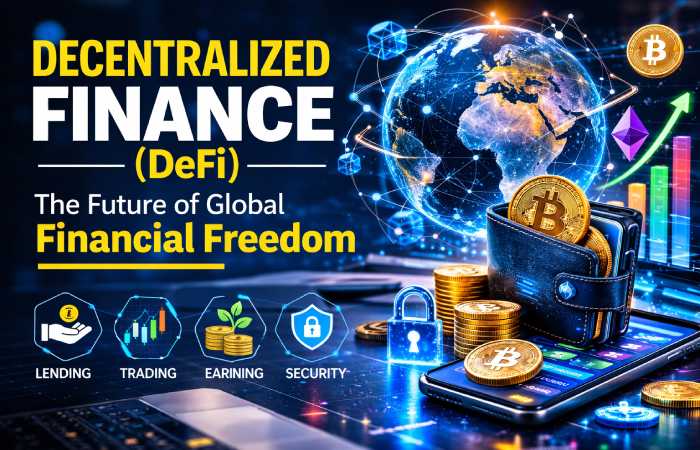
DeFi adoption varies significantly across different geographic regions due to regulatory frameworks, internet access, and cryptocurrency adoption levels.
| Region | Market Share | Key Growth Drivers |
|---|---|---|
| North America | 37% | Venture capital investment and blockchain innovation |
| Asia-Pacific | 33% | Rapid crypto adoption and fintech growth |
| Europe | 21% | Regulatory experimentation and institutional adoption |
| Middle East & Africa | 9% | Financial inclusion and mobile banking expansion |
North America currently leads the DeFi market, but Asia-Pacific is expected to experience the fastest growth as digital finance expands across emerging economies.
In regions with limited banking access, DeFi platforms enable individuals to access credit, savings, and international payments without traditional financial infrastructure.
How To Make Transactions Within A Decentralized Finance Ecosystem?
Currently, one of the most mutual means of making decentralized finance transactions is through the Ethereum ecosystem, which allows the use of smart contracts that are computer codes written to work in a self-executing way so that operations do not need intermediaries.
It is also worth noting that Ethereum is the second most used cryptocurrency in the world. For example, it has facilitated the recording of information and transactions. It is because it will already creat to offer options that bitcoin is still implementing.
Decentralized Finance (Defi): What Are Its Advantages?
No intermediaries or intermediaries will significantly reduce the costs associated with providing and using financial products and services. Thus, when contracting a loan through decentralized finance, for example, the operation is usually cheaper for the borrower and, at the same time, more profitable. Transparency is another positive point of this cryptocurrency segment. The ecosystem can only exist if the information will share with all users.
In the traditional financial system, which depends on the profit of intermediaries, services are generally not present in low-income communities. However, as Defi technology costs are much lower, everyone can benefit. As an open system, the ease of access for individuals who otherwise would not be able to enjoy any financial services is also among its advantages.
Is Defi Technology Secure?
Despite the advantages above, it is also essential to consider the other side of the coin: security. The good news is that, according to cybersecurity experts, blockchain technology is secure, making decentralized finance (Defi) safe.
However, this does not mean that scams are not apply, especially to novice users, who are not yet familiar with this market, as it is very new. Therefore, those who wish to carry out transactions via decentralized finance should inform themselves and carefully study its operation.
It is also worth noting that, contempt the security of the technology, there is a risk of error on the part of users. There is no intermediaries, so decentralized finance applications transfer responsibility to those who use them directly. Thus, if there is any human or technical error, there is no support service you can turn to in case of problems.
In addition, the present lack of regulation also weighs on the decision to carry out transactions through Defi technology. In fact, what is observed is that control bodies and governments still need to learn how to deal with this novelty of the financial market.
Is The Decentralized Finance Landscape Worth It?
Amid advantages and disadvantages, decentralized finance proves promising, and finance experts recommend it to anyone looking to invest in the cryptocurrency market.
However, they advise that caution will need in analyzing the risks and quality of available assets. It is because it is not always easy to make the best decision, given the novelty factor and the technical specificities involved. That is, you have to choose between so many existing Defi protocols carefully.
In short, information is the keyword to operate in the segment. In this sense, experts recommend attention to aspects such as the volume traded, the technical team behind the project, objective, and form of use. Finally, it is essential always to be suspicious of promises of guaranteed returns or absurd gains.
Comparing Decentralized Finance With Traditional Banking Systems
| Feature | Traditional Finance | Decentralized Finance |
|---|---|---|
| Control | Centralized institutions | Decentralized protocols |
| Access | Requires bank account | Requires crypto wallet |
| Transaction Speed | Hours or days | Minutes or seconds |
| Fees | Bank and intermediary fees | Network transaction fees |
| Transparency | Limited transparency | Public blockchain records |
| Regulation | Strict financial regulation | Evolving global regulation |
DeFi eliminates intermediaries and provides open financial infrastructure. However, traditional finance still offers consumer protections, regulatory oversight, and insurance systems that DeFi lacks.
Important New Updates and Industry Developments in DeFi During 2025–2026
Several major trends are shaping the DeFi industry in 2025 and 2026.
1. Institutional DeFi Integration
Traditional financial institutions are beginning to explore decentralized lending and tokenized assets. Real-world asset tokenization has already attracted billions of dollars in investment capital.
2. Expansion of Tokenized Real-World Assets
Assets such as government bonds, real estate, and commodities are being represented on blockchain networks, expanding the DeFi ecosystem beyond cryptocurrency.
3. Improved Security and Smart Contract Auditing
Security remains a major priority as hackers continue targeting DeFi protocols. Industry players are increasing spending on security audits and on-chain monitoring tools.
4. Regulatory Developments Worldwide
More than 29 countries have proposed new crypto regulations that may impact DeFi platforms and their legal compliance requirements.
5. Growth of Layer-2 Scaling Solutions
Layer-2 technologies reduce congestion and transaction fees, allowing DeFi platforms to process significantly more transactions with improved efficiency.
Conclusion
Decentralized Finance represents one of the most significant innovations in financial technology. By removing intermediaries and enabling automated financial services through smart contracts, DeFi provides a transparent and accessible financial infrastructure.
Although challenges such as regulatory uncertainty, market volatility, and cybersecurity risks remain, ongoing technological improvements and institutional adoption are strengthening the ecosystem.
As blockchain technology matures and regulations evolve, DeFi has the potential to complement traditional financial systems while expanding access to financial services worldwide.