
Table of Contents
Introduction
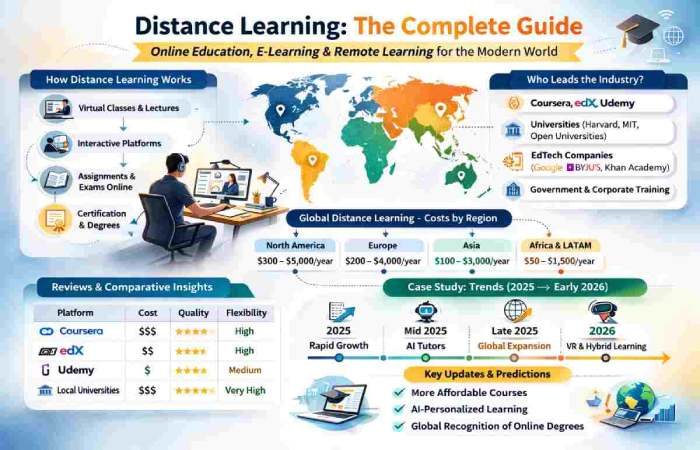
Distance learning—also known as online education, e-learning, or remote learning—has evolved from a fringe option to a mainstream educational model. Fueled by technological advances, flexible lifestyles, and global connectivity, online education enables learners of all ages and backgrounds to access quality learning without geographic limitations.
In this comprehensive guide, we explore:
-
How distance learning works
-
Who leads the industry
-
Costs across regions
-
Reviews and comparative insights
-
A case study tracking trends from 2025 to early 2026
-
Key updates and predictions
By the end of this article, you’ll have a thorough understanding of distance learning as it stands today and where it’s headed tomorrow.
Specialists in Distance Learning (Industry Leaders)
Below is a table summarizing major platforms, type of offerings, and what they specialize in:
| Organization / Platform | Type | Specialization | Best For |
|---|---|---|---|
| Coursera | MOOC & University Partners | Accredited courses, degrees | Lifelong learners & professionals |
| edX (now edX 3.0) | University-led | Academic coursework from top universities | Formal academic study |
| Udemy | Marketplace Platform | Practical skills & short courses | Career skills on demand |
| Khan Academy | Nonprofit | Free foundational learning | K-12 & basic skill building |
| FutureLearn | Global MOOC | Humanities & professional short courses | Global learners |
| LinkedIn Learning | Subscription | Professional certification track | Career advancement |
| Open Universities | Distance universities | Full degrees online | Degree seekers globally |
Expert Insight:
Distance learning is no longer “less than” traditional classrooms—many accredited programs now rival in-person equivalents in quality, recognition, and career impact.
Price Breakdown
Costs for distance learning vary significantly by provider, region, and level of credential.
| Provider / Program | Cost Range (USD) | Credential Type | Notes |
|---|---|---|---|
| Coursera | $39–$79 per course | Certificates | Subscription options available |
| edX University Courses | $300–$1,500 | College credits | Pathway to degree |
| Full Online Degrees | $5,000–$30,000+ | Bachelor’s/Master’s | Varies by institution |
| Udemy | $10–$200 | Course certificate | One-time payment |
| LinkedIn Learning | $29.99/mo | Subscription | Unlimited access |
| Khan Academy | Free | None | Foundation learning |
| Corporate Training Programs | $500–$5,000 | Professional | Often industry certified |
Key Observation:
While many online courses are affordable or free, accredited university degrees still carry a premium. However, compared to traditional campus costs, online degree programs can save learners 20–60% in tuition and living expenses.
Geographical Locations
Distance learning usage and adoption are global—however, adoption levels vary significantly by region.
| Region | % Adoption (2026) | Popular Platforms | Notes |
|---|---|---|---|
| North America | 85% | Coursera, LinkedIn, edX | Mature market |
| Europe | 78% | FutureLearn, Udemy | High multilingual demand |
| South Asia | 74% | Local LMS + Global | Massive student population |
| East Asia | 80% | Platform + University partners | High competition |
| Latin America | 68% | Coursera, local MOOCs | Rapid growth |
| Middle East | 62% | EdTech + University extensions | Government initiatives |
Trend Insight:
Regions investing in internet infrastructure—especially South Asia and Latin America—are experiencing rapid growth in online learning adoption, particularly for vocational training and technology skills.
Comparison: Distance Learning vs Traditional Education
| Aspect | Distance Learning | Traditional Education |
|---|---|---|
| Flexibility | High | Moderate |
| Cost | Moderate | Moderate |
| Accessibility | High | Moderate |
| Social Interaction | Moderate | High |
| Practical/Hands-on Experience | Moderate | Moderate |
| Career Recognition | Moderate | High |
| Technology Dependence | High | Moderate |
Conclusion: Distance learning excels in flexibility and accessibility, while traditional classroom settings still lead in face-to-face interaction and hands-on experiences for some fields.
How To Choose An Ead Course?
- Distance learning essay is nothing more than the act of studying a certain content without being in the same physical environment as the teacher. Therefore, it is an alternative to the conventional way we can also name online.
- You can take distance learning essay courses from wherever you are without having to go to the classroom to meet other students and teachers.
- In this case, the relationship between the student and the teacher takes place with the help of online tools available on the educational institution’s portal.
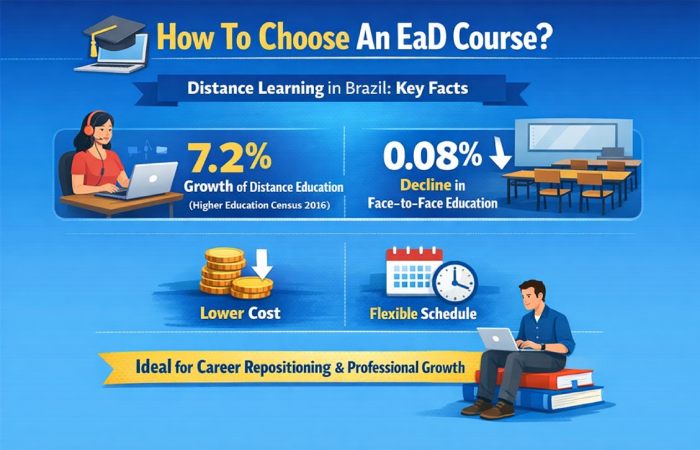
- It is worth mentioning that distance learning essay in Brazil is advancing at a faster pace than face-to-face learning.
- According to the 2016 Higher Education Census, at Inep (Anísio Teixeira National Institute of Educational Studies and Research), distance education expanded by 7.2%.
- In comparison, face-to-face teaching suffered an annual decline of 0.08%.
- This movement can explain two main factors: the low cost of these courses about the traditional ones and the flexible schedule for a study that they allow.
- It is undeniable that distance learning essay has made life easier for those seeking career repositioning or even professional growth.
Reviews: What Learners Are Saying (2026)
Teachers & Students
-
“I can balance work and study.” — Working professionals report improved work-life balance.
-
“Quality depends on program structure.” — Some platforms lack consistent academic rigor.
Employers & Recruiters
-
Employers increasingly value project-based and skill-oriented certifications from recognized platforms.
-
Full online degrees from reputable universities increasingly appear on job requirements.
Academic Experts
Distance learning is now considered a valid form of education, especially when paired with proper evaluation and assessment systems.
Conclusion
Distance learning has transformed from a supportive alternative into a robust educational ecosystem. In 2025–2026:
-
It continues to grow in relevance and recognition.
-
Costs are competitive compared to traditional models.
-
Global accessibility has never been higher.
-
A wide range of credible providers serve diverse needs.
The future of learning is flexible, technology-enhanced, and learner-centric. Whether you’re upskilling for career change, earning a degree, or seeking lifelong learning, distance learning offers pathways for everyone.
Disclaimer
The information in this article is based on current research and trends as of 2026. Prices, adoption rates, and platform offerings may change over time and across regions. Readers should verify details with official sources before making education investments.
Also read: Business Administration Course: Some Things You Need To Know